How We Built a Pricing Calculator With Claude (And Stopped Needing Our CEO on Every Sales Call)
Our sales team couldn't quote prices without a co-founder in the room. We fixed that with a spreadsheet, some rules, and Claude — in about a week.
I was at a conference in San Diego, sitting at a round table with a dean and a vice dean from a large public university in New York. We'd been building a relationship with them for a while. They were interested in what we did. And then came the question that used to stop every sales conversation cold:
"So what does this actually cost?"
I pulled out my iPad, opened a pricing calculator we'd built the week before, and said: "Let's find out together. This'll take about five minutes."
Fifteen minutes later they were leaning over the table, pointing at the screen, removing programs and adjusting numbers to fit their budget. We weren't pitching them anymore. We were working with them. That shift — from selling to someone to figuring it out with them — changed how we sold entirely. And the tool that made it possible took a few hours to build with the free Claude app.
The Problem That Existed Forever
I was a marketing manager at GradRight, an edtech company that helped universities recruit international students from India. It was B2B enterprise sales — we were selling to deans, VPs of enrollment, directors. Six-figure deals with a traditional sales funnel: discovery, demo, negotiation, contract, close.
The product was innovative, which was both our advantage and our biggest challenge. We weren't the traditional solution these universities were used to buying. When I joined, nothing was productized. Every deal was bespoke, every engagement was a custom proposal, and honestly the company had a hard time even explaining what it did to clients in a clear and concise way. That was the first problem I had to solve.
Over about five months, I learned everything we could offer, then packaged our services into distinct, productized solutions that were easier to understand, easier to sell, and easier to deliver. That alone was a major step forward.
But it created a new problem. Now that prospects actually understood what we did and were interested, they wanted to talk numbers. And nobody on the sales team could give them an answer.
The Bottleneck
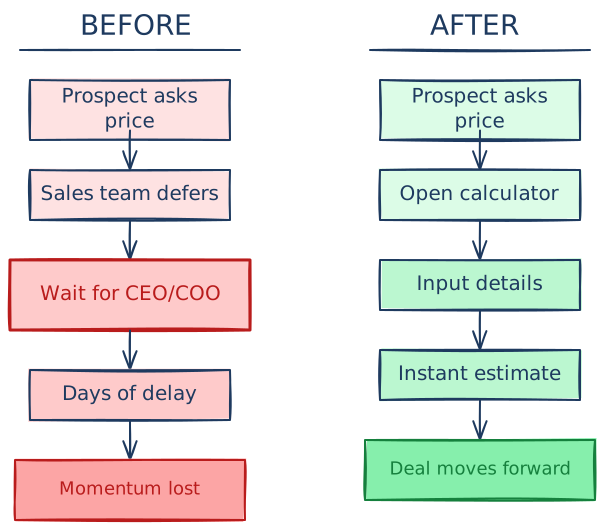
The only people who could quote a price were our CEO and COO. All the pricing logic was in their heads — the cost to deliver, our margins, the variables that changed from deal to deal. If a prospect asked "what does this cost?" on a call, we had to say "let us get back to you" and schedule a follow-up with a co-founder.
That's death in a sales cycle. It kills momentum. It limits how many conversations you can run in parallel. And it puts two already-busy founders on the hook for every deal that gets past discovery.
We had maybe a dozen active deals in the pipeline at any given time and this bottleneck was directly affecting a third to half of them — every deal that got to the negotiation stage. But it was probably hurting us earlier in the funnel too, in harder-to-measure ways. When you can't say anything about pricing in a first conversation, prospects keep their guard up. They're thinking what is this going to cost me the entire time instead of listening to what you can do for them.
The Real Work: Making the Pricing Explicit
Before we could build any tool, we had to do the harder thing: get the pricing logic out of our executives' heads and into something concrete.
This was essentially a business logic problem. Our pricing depended on real market conditions. If a university had a strong brand in India — students knew about it, wanted to go there — our cost to deliver enrollments was lower, so the price was lower. If they were relatively unknown, it cost us more to recruit students for them, and the price went up. If they wanted students for popular programs like tech or business, that was easier. Niche programs with low demand from Indian students? Harder and more expensive.
There were other factors too: how many enrollments they wanted, whether they'd invest in marketing and PR services through us (which would lower our acquisition costs over time), the timeline. Each of these variables affected the math.
We sat down — me and the co-founders — and codified all of this into a Google Sheet. Rules, formulas, scenarios. We tested it against different situations to make sure the numbers made sense. This took a day or two of focused work and a lot of discussion. It was the hardest part of the whole project, and also the most valuable, because it forced the company to be explicit about decisions that had always been made on instinct.
Our executives were comfortable in spreadsheets. That's where they liked to think and work. So we met them where they were. The spreadsheet was the product at that point — the AI part was just the last step.
Building the Calculator
We exported the Google Sheet, opened the Claude Mac app, uploaded the file, and asked it to turn it into an interactive pricing calculator on a web page.
That's it. No code editor. No development environment. No technical team. Just the normal Claude app that anyone can download. I don't even remember if we were on the paid tier or the free one — and honestly, it doesn't matter. Even the paid version is $20 a month, which is nothing for a business closing six-figure deals. And frankly, any model could do this now. You could use a free-tier model and get the same result.
Claude generated a working web page with form fields for each input — program types, number of enrollments, university characteristics — and it calculated a price estimate in real-time as you filled it in. We published it directly as a Claude artifact, which meant we didn't even need to worry about web hosting. No domain name, no deployment, no infrastructure. Just a link we could open on any device.
It worked on the first try. We iterated for maybe a couple of hours to clean up the user experience and make it presentable enough for a real sales meeting. The whole thing — from "let's try this" to using it with a real prospect — took about a week. The spreadsheet work took a day or two. The AI part took one working session.
The Conference
A few weeks later we were at NAFSA, a big international education conference in San Diego. We had a meeting with a large public university in New York — a dean and vice dean from their school of business. We'd been talking with them for a while and had built good rapport, but we wanted to see if they were ready to move forward seriously.
We gave them our pitch deck, explained how we worked, and did some discovery. Then, instead of waiting for the inevitable pricing question, we got ahead of it.
"We know you're going to want to know what this costs. You have a budget to worry about and we totally understand. We can give you a ballpark price estimate right here, right now."
I pulled up the calculator on my iPad. We asked them a few simple questions: What programs are you looking to recruit for? How many enrollments are you targeting? And based on what we knew about their university's profile and brand presence in India, we plugged in the relevant factors.
The numbers appeared on screen and they could see exactly why the price was what it was. This program costs more because there's less demand for it from Indian students. This one is cheaper because your university already has recognition in India for it. If you invest in some marketing services, that brings the overall cost down because it lowers our acquisition cost.
They got it. It clicked. They could see the connection between what they were asking for and what it would cost, and they could see that we weren't hiding anything. No markup mystery. No "trust us, this is a fair price." The math was right there.
Working With Them, Not Selling To Them
This was the real shift. The pricing conversation stopped being adversarial and started being collaborative.
One prospect — different meeting, same tool — went through the calculator and the total cost was too high for their budget. But instead of walking away, they started adjusting. They were looking at five programs. They dropped it to three — their highest priorities. Instead of ten enrollments per program, they tried five for the first year. The per-student cost actually went up slightly, but the total budget came way down into a range they could work with. They moved forward.
That conversation would have been impossible without the tool. Before, the prospect would have heard a number, said "that's too much," and we'd have said "let us go back and see what we can do." Days of back-and-forth emails with a co-founder in the loop. Now they were solving the problem themselves, in real-time, with us right there.
The important thing is that this wasn't a final price quote. It was a ballpark estimate — enough for someone to raise their hand and say "yes, I'm interested, let's keep talking" or "no, we're not even in the same neighborhood." That distinction mattered. It lowered the stakes of the conversation while still giving them real, useful information.
What Made This Work
It wasn't the AI. The AI was the last mile.
What made this work was doing the business thinking first. Productizing our offerings so they were clear. Sitting down with executives and turning instinct-driven pricing into explicit rules. Testing those rules against real scenarios. Getting it into a spreadsheet where people could see the logic.
Once that foundation existed, turning it into a tool was the easy part. Claude handled it in a few hours. We published it as an artifact and used it the next week. No developer needed. No project plan. No sprint. Just a business problem, clearly defined, turned into a simple tool with AI.
And that's what I think a lot of people miss about AI in business right now. The technology is accessible — genuinely accessible. You don't need a technical background to do what we did, though it helps if you want to refine it. The barrier isn't the tool. The barrier is doing the thinking that comes before the tool. Knowing your business well enough to define the rules. Understanding your customer well enough to know what they need to see. Having the clarity to turn a messy, in-someone's-head process into something explicit and repeatable.
If your team has knowledge bottlenecks — things that only one or two people can do because the logic lives in their heads — that's the thing to fix. Define the logic. Put it in a spreadsheet. And then let AI turn it into something your whole team can use. It's faster and cheaper than you think.